26/27 concept project
Trasa: road haulage and forwarding · Stryków
Customers put their pallets on the trailer, see how much space they take and send a quote request with all the details.
Concept project - how I would build a website for a business in this field: road haulage and forwarding. The business and its details are fictional.
- Field
- road haulage and forwarding
- City
- Stryków
- Languages
- PL / EN / DE
- Year
- 2026
- Speed
- 100/100 · 100/100
01The challenge
Haulage companies usually have a list of services, a photo of a truck and a “contact us” form on their website. So customers write “how much to Berlin?”, and the forwarder replies with questions: how many pallets, what kind, how heavy, can they be stacked, when is loading. Several emails or calls go by before there is a quote. This is how I would build a site for a carrier and forwarder in Stryków, central Poland, that runs full and part loads across Poland and to Germany, the Benelux, Czechia and Scandinavia: customers first see their load on the trailer, then send a request with nothing missing. In Polish, English and German, because orders also come from companies abroad.
02What I did
-
The trailer from above instead of a truck photo
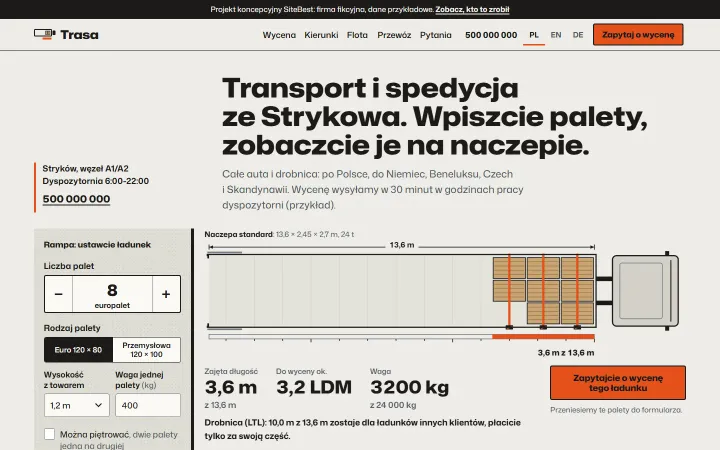
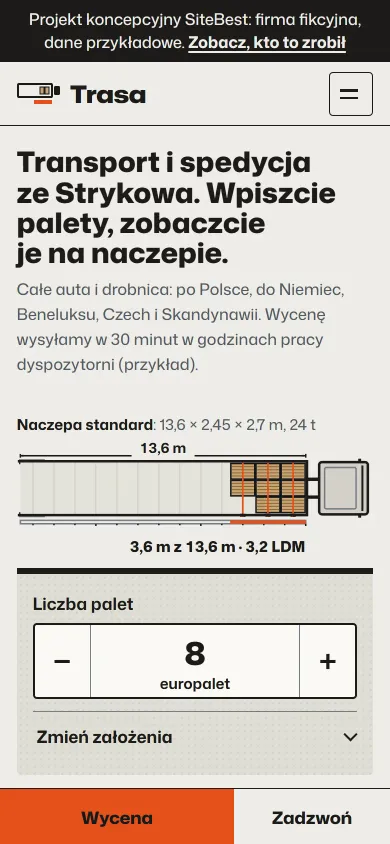
The first screen is a 13.6 m trailer seen from above. Next to it is a warehouse dock with a big pallet counter: click plus and another pallet rolls in through the rear doors, and every full row gets an orange strap. Under the floor a measure grows with a label such as “3.6 m of 13.6 m”. On the dock you also pick the pallet type (euro or industrial), height with goods, weight per pallet, stacking and the vehicle. With reduced motion the pallets are simply in place, and without JavaScript the page shows a table of typical loads.
-
Loading metres explained in words
Carriers price part loads in loading metres (LDM), and few people outside the trade know what that means. So the result shows two numbers and a sentence: how much floor the pallets take and how many LDM go into the quote. For 8 euro pallets that is 3 rows, 3.6 m of floor, formally 3.2 LDM. Next to it is the weight against the vehicle’s payload and a hint: part load, part of the trailer or a full truck. The page also says plainly that carriers charge by metres or by weight, whichever is higher, with an example rate of 1 LDM = 1,500 kg and a note that every carrier has its own table.
-
Numbers that match the drawing
The planner counts the way pallets are really loaded: euro pallets three across, in rows of 1.2 m, so a standard trailer takes 33. Stacking only works when two pallets fit in the inside height. At 34 euro pallets the page does not pretend everything fits: the first truck is full and one pallet stays on the dock, labelled as waiting for a second truck. Each of these cases is checked by tests against results worked out by hand, and the vehicle dimensions come with dated sources.
-
A quote request with nothing missing
The button under the trailer carries the pallets over to the form. Only four things are required: from, to, the first loading day and an email or phone number. A mixed load goes in as a list of items, and a card next to the form, “What the dispatcher gets”, shows live how the request looks on the other side. After sending, the customer gets a request number and a cancellation link, and instead of sending the message the demo shows a preview of it. The form is protected from spam by a check that usually stays completely out of sight.
-
A dispatcher dashboard
Requests land in a simple dashboard: a list with the route, dates, pallets and loading metres, and the statuses “new”, “quote sent” and “closed”. The code for the demo dashboard is public (TRASA-DEMO), and contact details are partly hidden. The dashboard is in Polish, because a Polish dispatch office works in it.
-
Kilometres instead of a map of Europe
Destinations are shown on a ruler of kilometres from Stryków, with bands for each day of driving: Poland up to about 320 km, Berlin about 460 km, Prague about 520 km, Rotterdam about 1,110 km, Gothenburg about 1,150 km. The page counts like a driver, about 650 to 700 km a day with one driver, so customers see at once whether goods arrive the same day or the next. The fleet is four vehicles drawn to the same scale as the trailer at the top: a standard trailer, a mega trailer, a reefer and a 7.5 t rigid truck. Clicking one sets it in the planner.
-
Lashing straps and one typeface
The page’s motif is orange lashing straps with a ratchet: they hold the pallets on the trailer and separate the sections. The course of a job is written like a dispatch log, with times: from the request on Tuesday morning, through loading and unloading in Berlin, to proof of delivery as a PDF the same day. The whole page is set in one typeface, Mona Sans, with wide, heavy headings and no thin weights, so numbers and dimensions are easy to read on a phone too.
-
Three languages, honestly labelled
The English and German versions are written separately, the German one in the formal form of address and with the vocabulary forwarders use. The business, the review, the phone number and the documents are made up and labelled as such: the promise of a quote in 30 minutes, the review and the licence and insurance plates are marked “example”, and the photos are AI-generated.
03Result
A carrier and forwarder’s website in three languages where customers check how much space their load takes, understand loading metres without a glossary and send a quote request with all the details. The forwarder gets everything in one message and does not have to ask about dimensions. Speed 100/100 on mobile and on desktop, accessibility 100, and nothing jumps while the page loads.
100phone
100desktop
measured:
04DNA card
What the finish is made of
Click a color, typeface or corner style to strip it from the preview. What remains is the bare structure - the same one every website of mine stands on.
Colors
Heading typeface
Corner radius
05Found on Google
How customers find this website
- The title says who, from where and how they quote: haulage and forwarding from Stryków, priced by loading metres.
- Google knows it is a haulage company and knows its services (full loads, part loads, reefers, forwarding) and the countries it serves.
- The most common questions are set up so Google and AI assistants can quote the answers.
- The Polish, English and German versions are linked, so Google shows the right language.
- The demo is hidden from search engines, because the business is fictional.